Branchennachrichten
 Zuhause / Aktuelle Nachrichten / Branchennachrichten / Raw to Shelf-Stable: The Engineering of Pet Care Freeze Drying Equipment
  2026.06.11
 Branchennachrichten
For pet food manufacturers seeking to produce shelf-stable raw diets without cooking or chemical preservatives, freeze drying is the only industrial method that retains nutritional integrity. Comparative testing shows freeze-dried raw pet food retains 94-97% of original vitamins, enzymes, and amino acids, compared to 20-40% retention in extruded or heat-dried products . The direct conclusion: pet care freeze drying equipment with proper shelf temperature control (-30°C to -40°C freezing, 40°C to 60°C primary drying) and vacuum pressure below 100 mTorr produces finished products with less than 4% moisture content and 12-24 month ambient shelf life. This article provides specific selection criteria based on batch size, product type (meat chunks, whole prey, toppers), and throughput requirements for pet food applications.
Gefriertrocknungsgeräte für die Tierpflege operates on the principle of sublimation: converting frozen water directly to vapor without passing through a liquid phase. Der Prozess besteht aus drei verschiedenen Phasen: Gefrieren, Primärtrocknung (Sublimation) und Sekundärtrocknung (Desorption). The freezing phase must achieve core product temperatures of -30°C to -40°C to ensure complete crystallization of free water . Meat and organ tissues freeze at different rates; Geräte müssen über programmierbare Abkühlraten von 1–3 °C pro Minute verfügen, um die Bildung von Eiskristallen zu verhindern, die die Zellwände schädigen. Die Primärtrocknung macht 85–90 % der gesamten Zykluszeit aus, typischerweise 24–48 Stunden für 2,5 cm dicke Fleischstücke. Secondary drying removes bound water to achieve final moisture below 4%, requiring an additional 4-8 hours at 50°C to 60°C shelf temperature.
Das Vakuumsystem ist die kritischste Komponente. Industrial pet care freeze drying equipment must achieve chamber pressure below 100 mTorr (0.0133 kPa) during primary drying . Higher pressures raise the sublimation point, causing frozen product to melt and boil rather than sublime, resulting in collapsed structure and nutrient loss. Vacuum pump capacity should be sized to evacuate the chamber from atmospheric pressure to 500 mTorr within 20 minutes; slower evacuation allows surface ice to melt before sublimation begins.
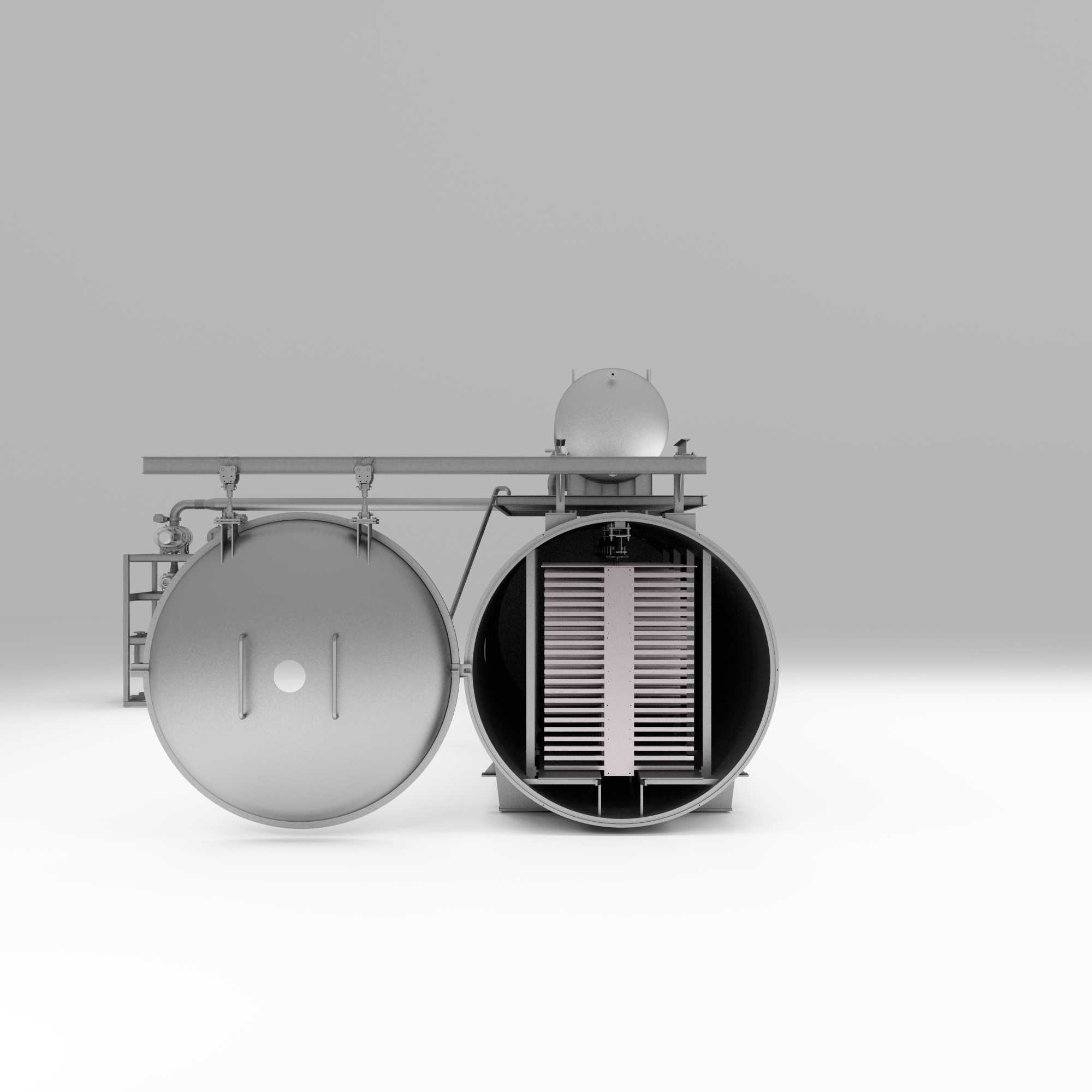
Pet food freeze dryers use heated shelves (platens) with product loaded on trays. Shelf temperature uniformity is non-negotiable: all shelves in the chamber must maintain temperature within ±2°C across the entire surface . Temperature variation above ±3°C causes uneven drying: product on hot spots scorches (surface temperatures exceeding 65°C denature proteins), while product on cold spots remains wet, requiring extended cycle times that reduce throughput by 20-30%. Request thermal mapping data for the specific chamber configuration before purchase; suppliers should provide 16-point thermocouple maps at three shelf levels.
Heat transfer to the product occurs through three mechanisms: conduction from the shelf to the tray, radiation from shelves above, and convection through the reduced-pressure gas. For maximum sublimation rate, shelf heating should be provided by silicone oil circulating through the platens, not electric resistance heaters . Ölbeheizte Regale erreichen Anstiegsraten von 5–8 °C pro Minute und sorgen für eine Stabilität von ±1 °C. Elektrisch beheizte Regale weisen typischerweise eine Temperaturschwankung von ±5 °C und langsamere Anstiegsraten auf, wodurch sich jeder Zyklus um 4–8 Stunden verlängert. For a facility running 300 cycles per year, this difference represents 1,200-2,400 additional operating hours annually.
| Produktionsmaßstab | Regalfläche (m²) | Batch Size (kg raw) | Cycle Time (hours) | Jährlicher Durchsatz (kg) |
|---|---|---|---|---|
| Startup/Artisanal | 2-5 | 10-25 | 36-48 | 2,000-8,000 |
| Small Commercial | 8-15 | 40-75 | 32-40 | 15,000-50,000 |
| Mittelgroße Produktion | 20-40 | 100-200 | 30-36 | 50,000-200,000 |
| Industrial Large Scale | 50-100 | 250-500 | 28-32 | 200.000-1.000.000 |
Different pet food ingredients require different freeze drying parameters. Ground meat and organ blends (30-50% fat content) freeze and dry differently from whole muscle pieces or bone-in products . Fett hat kein gebundenes Wasser und sublimiert nicht; high-fat products require longer secondary drying to prevent residual moisture from being trapped beneath fat layers. For raw pet food containing 40% fat (e.g., duck, lamb blends), extend secondary drying by 6-8 hours and maintain shelf temperature at 55°C to ensure fat-capillary moisture release. Failure to do so results in spoilage within 3-4 months despite achieving target moisture content of 4%.
Whole prey items (mice, chicks, fish) present unique challenges. The internal cavity retains moisture longer than external tissue. Whole prey freeze drying requires an additional 12-24 hours of primary drying compared to ground product of equivalent mass . Die Ausrüstung muss Lasten unterschiedlicher Höhe aufnehmen können. shelves with adjustable spacing (minimum 50mm clearance above product) are essential for whole prey. Without adequate clearance, sublimated water vapor cannot escape from the product surface, creating a localized vapor barrier that slows drying by 50-70% and allows bacterial growth in the temperature danger zone (0-40°C) during the transition from freezing to drying.
Pet care freeze drying equipment requires two-stage rotary vane vacuum pumps with ultimate pressure below 10 mTorr (0.0013 kPa). Pump displacement (CFM) must be sufficient to evacuate the chamber volume to 500 mTorr within 15 minutes for batch sizes under 100 kg, 20 minutes for larger batches . Under-sized pumps extend evacuation time, allowing frozen product surfaces to warm above -20°C before vacuum is established, causing surface ice to melt into the product. This melted water then boils when vacuum reaches 4,000 mTorr, creating steam bubbles that rupture cell walls and produce a spongy, unattractive texture that pet owners perceive as low quality.
Vacuum pump oil degrades rapidly due to moisture absorption from the chamber. For pet food freeze drying, change pump oil every 100-150 operating hours, versus 500 hours for pharmaceutical freeze dryers . Pet food loads contain 70-80% water by mass, and despite condenser traps, some moisture reaches the vacuum pump. Contaminated pump oil loses ultimate vacuum capability; Eine Pumpe, die mit frischem Öl 50 mTorr erreicht hat, erreicht möglicherweise nach 200 Stunden Verwendung mit Tiernahrung nur noch 500 mTorr. Install an oil filtration system (1 micron nominal rating) and oil mist eliminator to extend pump service intervals to 250-300 hours. Annual vacuum pump maintenance costs for a 100 kg batch freeze dryer typically run $1,500-2,500.
The condenser (cold trap) captures water vapor sublimated from the product. Die Kondensatorkapazität muss für 150 % der maximalen Wasserlast in einer einzelnen Charge ausgelegt sein . For a 100 kg batch of raw meat (75 kg water content), the condenser must capture at least 110 kg of ice without reaching capacity and losing vacuum. Undersized condensers force premature defrost cycles, interrupting drying and destroying batch integrity. Specify a condenser with surface temperature below -50°C throughout the ice accumulation zone; Bei wärmeren Kondensatoren bildet sich eine isolierende Schicht aus Eis, die nach einer Ansammlung von 2 cm die Auffangeffizienz um 50 % verringert.
Heißgasabtauung versus Elektroabtauung: Hot gas defrost completes in 30-45 minutes versus 2-3 hours for electric defrost . Bei Anlagen, die 2–3 Chargen pro Tag betreiben, nimmt die elektrische Abtauung täglich 8–9 Stunden in Anspruch, wodurch der Durchsatz effektiv um 30–40 % reduziert wird. Hot gas defrost uses compressor discharge gas to heat the condenser coil, requiring additional valving but paying for itself within 6-12 months through increased production capacity. However, hot gas defrost requires larger refrigerant charge (30-50% more) and increases annual maintenance costs by $500-1,000 for valve servicing.
Der Zusammenhang zwischen Losgröße und Zykluszeit ist nichtlinear. Eine Verdoppelung der Last von 50 kg auf 100 kg erhöht die Zykluszeit normalerweise um 50–70 %, nicht um 100 %. The optimal load for most pet care freeze drying equipment is 70-80% of maximum shelf capacity . At 100% load, air circulation between trays is restricted, increasing drying time by 30-40% for the same product mass. For 1-inch thick meat pieces on 20 m² of shelf area, maximum practical load is 150-180 kg; exceeding this causes the bottom trays to finish 8-12 hours after top trays, forcing operators to either over-dry the top product or accept under-dried bottom product.
Die Schalenkonfiguration beeinflusst die Gleichmäßigkeit der Trocknung. Edelstahlgitterwannen (2 mm Drahtabstand) trocknen 15–20 % schneller als feste Wannen, da Wasserdampf sowohl an der Ober- als auch an der Unterseite entweicht. Bei festen Schalen muss das Produkt 50 % der Zykluszeit gewendet werden, was zu zusätzlichen Arbeitskosten von 15–25 US-Dollar pro Charge und möglicherweise zu Verunreinigungen führt . For pet food applications, mesh trays are recommended despite higher initial cost ($200-400 per tray versus $50-100 for solid). Gitterschalen halten bei ordnungsgemäßer Reinigung 5–10 Jahre. Feste Schalen entwickeln innerhalb von 2–3 Jahren Lochfraß und Kontaminationsfallen.
Pet care freeze drying equipment requires cleaning between batches when switching protein sources or at minimum every 72 hours of continuous operation. Failure to clean leads to biofilm formation in chamber crevices, with studies showing 1,000-10,000 CFU/cm² of aerobic bacteria after 7 days of raw pet food processing . Das Reinigungsprotokoll muss für das spezifische Kammerdesign validiert werden:
Equipment designed for clean-in-place (CIP) with spray balls on all internal surfaces reduces cleaning time from 4-6 hours to 1-2 hours. CIP adds 15-25% to equipment cost but reduces labor costs by $15,000-25,000 annually for a facility running 300 batches per year. For manual cleaning, ensure all chamber internal surfaces are accessible; Regalsysteme mit festen Stützen, die tote Winkel erzeugen, sind für die Verwendung in Tiernahrung nicht akzeptabel.
Pet care freeze drying equipment is energy-intensive. A 20 m² freeze dryer consuming 25-35 kW during operation requires 0,8-1,2 kWh pro kg verarbeitetes Rohprodukt . At $0.12/kWh, energy cost is $0.10-0.14 per kg of raw input. Since freeze drying removes 70-80% of weight as water, finished product energy cost is $0.50-0.70 per kg—significantly higher than heat drying (0.05-0.10 per kg) but justified by nutritional retention.
Refrigeration system COP (coefficient of performance) significantly affects operating cost. Scroll compressors for the refrigeration loop achieve COP of 2.5-3.0; Kolbenkompressoren erreichen 1,8-2,2 . A scroll compressor unit consuming 18 kW for refrigeration versus a reciprocating unit consuming 24 kW saves $0.72 per operating hour at $0.12/kWh, or $5,000-6,000 annually for a 7,000-hour/year operation. The premium for scroll compressors ($3,000-5,000) pays back in less than one year. For facilities in warm climates (annual average ambient >25°C), specify water-cooled condensers for the refrigeration system rather than air-cooled; water cooling improves COP by 15-20% and reduces annual energy costs by $3,000-8,000.
Modern pet care freeze drying equipment includes programmable logic controllers with recipe storage and data logging. Mindeststeuerungsfunktionen: Regaltemperaturprofil (mindestens 10 programmierbare Segmente), Vakuumsollwert mit automatischer Steuerung, Überwachung der Kondensatortemperatur und Produkttemperatureingang (mindestens 4 Thermoelementsonden pro Charge) . For pet food processing, the system must generate complete cycle reports including temperature and pressure traces at 5-minute intervals. These reports are essential for food safety audits and batch traceability under FSMA and similar regulations.
Fernüberwachung und Alarmmeldung werden dringend empfohlen. Automatisierte Warnmeldungen bei Ausfall der Vakuumpumpe (Kammerdruck steigt über 500 mTorr), Ausfall der Kühlung (Kondensatortemperatur über -40 °C) oder Stromunterbrechung verhindern Chargenverluste . Eine einzelne Charge roher Tierfutterzutaten im Wert von 5.000 bis 20.000 US-Dollar kann gerettet werden, wenn innerhalb von 30 Minuten ein Stromausfall festgestellt wird; without notification, the batch may thaw and spoil before operators return. Cellular or Ethernet-based monitoring systems cost $500-1,500 initial plus $200-400 annual subscription; one prevented batch loss typically covers 5-10 years of monitoring costs.
All surfaces contacting pet food must be 316L stainless steel, not 304 stainless. Edelstahl 304 korrodiert, wenn er dem Chloridgehalt von rohem Fleisch und Knochen (1.000–2.000 ppm Chlorid) ausgesetzt wird, und zeigt in Gefriertrocknern für Tiernahrung innerhalb von 6–12 Monaten Lochfraß . 316L stainless contains molybdenum (2-3%), providing resistance to chloride-induced pitting. Materialzertifizierungen überprüfen; some manufacturers use 304 for non-product-contact surfaces but 316L on product-contact surfaces is the minimum acceptable specification. Regaloberflächen müssen eine Oberflächenbeschaffenheit von Ra ≤ 0,8 µm (elektropoliert oder mechanisch poliert) aufweisen, um die Anlagerung von Bakterien zu verhindern und die Reinigung zu erleichtern.
Chamber welds require full penetration and smooth grinding. Weld crevices and undercuts are the primary sites of biofilm formation in freeze dryers . Überprüfen Sie die Schweißnähte mit einem Endoskop, bevor Sie die Lieferung annehmen. any weld with visible undercut, porosity, or mismatch should be rejected and reworked. Gaskets and seals must be FDA-compliant silicone (not EPDM or nitrile, which absorb fat and become sticky). Ersetzen Sie die Türdichtungen alle 12–18 Monate; seal degradation is the most common cause of vacuum leaks in freeze dryers older than 2 years.
Gefriertrocknungsgeräte für die Heimtierpflege erfordern eine umfangreiche Anlageninfrastruktur, die über die Grundversorgung hinausgeht. Spezieller dreiphasiger 400-600-A-480-V-Stromanschluss für einen 20-40 m² großen Gefriertrockner , plus separate 100-200 amp service for vacuum pumps and refrigeration. Druckluft für Pneumatikventile (7 bar, 100-200 L/min, getrocknet auf -40°C Taupunkt). Kühlwasser für wassergekühlte Kondensatorsysteme (20–40 l/min bei 25 °C maximaler Einlasstemperatur, 0,2–0,4 MPa Druck). Ohne ordnungsgemäße Wasseraufbereitung entwickeln Kühltürme innerhalb von 3–6 Monaten einen Biofilm, der die Kondensatorplatten verstopft.
Die Bodenbelastung ist beträchtlich: Ein 40 m² großer Gefriertrockner mit voller Produktbeladung wiegt 15.000–25.000 kg und erfordert eine Bodenbelastung von 1.500–2.500 kg/m². Die meisten industriellen Betonplatten (3.500–5.000 psi) sind ausreichend, Mezzanine-Installationen sind jedoch im Allgemeinen nicht möglich. Die Deckenhöhe muss für die Kammer geeignet sein, plus 1,5 Meter Freiraum über der Decke zum Entfernen und Warten der Regale. Mindestens 4,5 Meter vom fertigen Boden bis zur tragenden Decke. Belüftung zur Wärmeabfuhr: Ein 30-kW-Gefriertrockner gibt 40–50 kW Wärme an den Raum ab und erfordert 5–8 Luftwechsel pro Stunde (mindestens 2.000–3.000 CFM Abluft für einen 50 m² großen Raum).


Sienos gesamte Serie von Gefriertrocknungsanlagen, die von der experimentellen Forschung bis zum industriellen Maßstab reicht, ist energieeffizient, stabil und zuverlässig, mit flexibler Anpassung als Kernstück, hin zur Produktion, Prozessoptimierung und grünen Fertigungslösungen in mehreren Bereichen.
Sieno bietet auf Basis der Forschung zu intelligenten gefriergetrockneten Lebensmitteln maßgeschneiderte Prozesse für die gesamte Kette der Gefriertrocknungstechnologie (einschließlich Vorbehandlung, Gefriertrocknung und Verpackung) und hilft Unternehmen, Verbesserungen in Effizienz, Qualität und Umweltschutz zu realisieren.
Ausrüstung & Lösung
Lebensmittelindustrie Pharmaindustrie Landwirtschaft Haustierindustrie Schönheitspflegeindustrie Chemieingenieurwesen & Labor Umweltschutz & KreislaufwirtschaftSchnellzugriffe
Zuhause Produkt & Service Über uns Schlüsselfertige Lösungen Aktuelle Nachrichten KontaktKontaktinformationen
 +86-180 6875 7376
  +86- (0) 519-8578 6988
 emmy@jsblk.com
  Stadt Zhenglu, Bezirk Tianning, Stadt Changzhou, Provinz Jiangsu, China
Folgen Sie uns
Urheberrecht ©
Sieno Freeze-drying Technology Research Institute (Jiangsu) Co., Ltd
Alle Rechte vorbehalten
Kundenspezifische Komplettlösungen für Gefriertrocknungsanlagen